 English
 Español
  Português
  русский
  Français
  日本語
日本語  Deutsch
  tiếng Việt
  Italiano
  Nederlands
  ภาษาไทย
  Polski
  한국어
한국어  Svenska
  magyar
  Malay
Malay  বাংলা ভাষার
  Dansk
Dansk  Suomi
Suomi  हिन्दी
  Pilipino
  Türkçe
  Gaeilge
  العربية
  Indonesia
  Norsk
Norsk  تمل
تمل  český
český  ελληνικά
  український
  Javanese
  فارسی
فارسی  தமிழ்
தமிழ்  తెలుగు
  नेपाली
  Burmese
  български
  ລາວ
ລາວ  Latine
  Қазақша
  Euskal
  Azərbaycan
  Slovenský jazyk
  Македонски
  Lietuvos
  Eesti Keel
  Română
  Slovenski
  मराठी
मराठी  Srpski језик

Call Us
+86-15805363117
Email Us
dopinew@gmail.com

How Does a Revolving Door Improve Building Efficiency and User Experience?
Article Summary
A revolving door is more than just an architectural feature—it is a practical solution for controlling airflow, enhancing energy efficiency, and managing high pedestrian traffic. This article explores how revolving doors function, their key advantages, technical specifications, and how to choose the right model for different applications. It also addresses common customer concerns such as durability, safety, and installation, helping decision-makers select the most suitable solution.
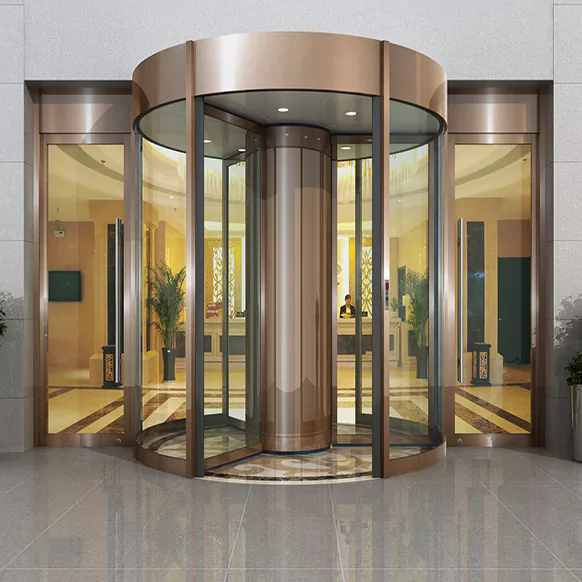
Table of Contents
- 1. What Is a Revolving Door?
- 2. How Does a Revolving Door Work?
- 3. Key Benefits for Modern Buildings
- 4. Technical Specifications and Features
- 5. Types of Revolving Doors
- 6. How to Choose the Right Revolving Door
- 7. Installation and Maintenance Considerations
- 8. Frequently Asked Questions
- 9. Conclusion
1. What Is a Revolving Door?
A revolving door is a circular entrance system consisting of multiple panels that rotate around a central axis. It is typically installed at the main entrance of commercial buildings, hotels, airports, and office complexes. Unlike traditional swing or sliding doors, revolving doors maintain a constant seal between indoor and outdoor environments.
This unique design minimizes air exchange, making it a preferred choice for buildings that prioritize climate control, energy efficiency, and aesthetic appeal.
2. How Does a Revolving Door Work?
A revolving door operates through a central shaft connected to rotating door panels. Users push the panels manually or rely on automatic sensors that control the rotation speed.
- Central shaft ensures smooth rotation
- Door wings divide the space into sealed compartments
- Sensors detect motion and adjust speed in automatic models
- Speed control systems ensure user safety
The continuous rotation allows people to enter and exit simultaneously without allowing external air to flow freely into the building.
3. Key Benefits for Modern Buildings
Customers often face challenges such as energy loss, uncontrolled airflow, and inefficient entrance management. Revolving doors address these issues effectively.
- Energy Efficiency: Reduces heating and cooling losses
- Climate Control: Maintains stable indoor temperature
- Traffic Flow: Supports high pedestrian volume
- Noise Reduction: Minimizes external noise intrusion
- Enhanced Aesthetics: Adds a modern architectural element
For large commercial buildings, these advantages translate into lower operational costs and improved user comfort.
4. Technical Specifications and Features
| Parameter | Description |
| Diameter | Common sizes range from 2000mm to 4800mm |
| Height | Customized according to building entrance |
| Material | Aluminum alloy, stainless steel, or glass |
| Drive Mode | Manual or automatic |
| Control System | Sensor-based intelligent control |
| Safety Features | Anti-collision sensors, emergency stop |
| Energy Saving | Reduces air exchange between indoor and outdoor |
Manufacturers like Duoping provide high-performance revolving door systems designed with precision engineering, ensuring long-term durability and reliable operation in high-traffic environments.
5. Types of Revolving Doors
Understanding the different types helps customers choose based on functionality and building requirements.
- Manual Revolving Door: Cost-effective and simple operation
- Automatic Revolving Door: Equipped with sensors for convenience
- Three-Wing Door: More spacious compartments
- Four-Wing Door: Higher energy efficiency and better sealing
Each type offers unique advantages depending on traffic volume and design preferences.
6. How to Choose the Right Revolving Door
Selecting the right revolving door requires evaluating multiple factors to ensure optimal performance.
- Building Type: Commercial, hotel, airport, or office
- Traffic Volume: High or moderate pedestrian flow
- Energy Efficiency Needs: Climate-sensitive environments
- Safety Requirements: Compliance with safety standards
- Design Aesthetics: Match with architectural style
Working with a trusted supplier ensures access to customized solutions that meet specific project requirements.
7. Installation and Maintenance Considerations
Proper installation and maintenance are essential for ensuring long-term performance and safety.
- Ensure accurate alignment during installation
- Regularly inspect sensors and control systems
- Lubricate moving components for smooth operation
- Conduct routine safety checks
Scheduled maintenance helps prevent unexpected breakdowns and extends the lifespan of the system.
8. Frequently Asked Questions
Q1: Are revolving doors safe for all users?
Yes. Modern revolving doors are equipped with advanced safety sensors, emergency stop functions, and speed control systems to ensure safe operation for all users.
Q2: Do revolving doors really save energy?
Yes. Their design significantly reduces air exchange, helping maintain indoor temperature and lowering heating and cooling costs.
Q3: What is the difference between three-wing and four-wing doors?
Three-wing doors provide larger walking space, while four-wing doors offer better sealing and higher energy efficiency.
Q4: Can revolving doors be customized?
Yes. Dimensions, materials, finishes, and control systems can be tailored to meet specific architectural and operational needs.
9. Conclusion
Revolving doors play a crucial role in modern building design by improving energy efficiency, enhancing user experience, and supporting smooth pedestrian flow. Their ability to maintain indoor climate stability makes them an essential component for commercial and high-traffic environments.
Duoping offers advanced revolving door solutions engineered for performance, safety, and durability, helping businesses achieve efficient and visually appealing entrances.
If you are planning to upgrade your building entrance or need a customized revolving door solution, contact us today to explore professional options and receive expert support tailored to your project requirements.
Send Inquiry
-
E-mail
X
We use cookies to offer you a better browsing experience, analyze site traffic and personalize content. By using this site, you agree to our use of cookies.
Privacy Policy
News
 Explaining the key points and safety guidelines for installing white glass2026/01/28
During the installation process, precise operation and detailed handling are particularly crucial. For the installation of white glass in different scenarios, differentiated specifications must be followed. When installing white glass for doors and windows, the glass surface orientation must comply ......
 Know these 6 key indicators of aluminum alloy door and window materials!2026/01/28
The series number indicates the thickness of the door frame in millimeters. Aluminum alloy sliding doors are available in 70 and 90 series; the 70 series is sufficient for interior residential aluminum alloy sliding doors.