 English
 Español
  Português
  русский
  Français
  日本語
日本語  Deutsch
  tiếng Việt
  Italiano
  Nederlands
  ภาษาไทย
  Polski
  한국어
한국어  Svenska
  magyar
  Malay
Malay  বাংলা ভাষার
  Dansk
Dansk  Suomi
Suomi  हिन्दी
  Pilipino
  Türkçe
  Gaeilge
  العربية
  Indonesia
  Norsk
Norsk  تمل
تمل  český
český  ελληνικά
  український
  Javanese
  فارسی
فارسی  தமிழ்
தமிழ்  తెలుగు
  नेपाली
  Burmese
  български
  ລາວ
ລາວ  Latine
  Қазақша
  Euskal
  Azərbaycan
  Slovenský jazyk
  Македонски
  Lietuvos
  Eesti Keel
  Română
  Slovenski
  मराठी
मराठी  Srpski језик

Call Us
+86-15805363117
Email Us
dopinew@gmail.com

How Does a Revolving Door Improve Building Efficiency?
Abstract
A revolving door is more than just an architectural entrance—it is a highly engineered access system designed to improve energy efficiency, regulate indoor climate stability, enhance pedestrian flow, and strengthen building security. In modern commercial buildings, airports, hotels, hospitals, and corporate headquarters, revolving doors are increasingly adopted as a sustainable solution to reduce HVAC energy loss and improve user experience. This article explores the working principles, advantages, selection criteria, installation considerations, and maintenance strategies of revolving doors, with practical insights from industry applications and solutions provided by Duoping.
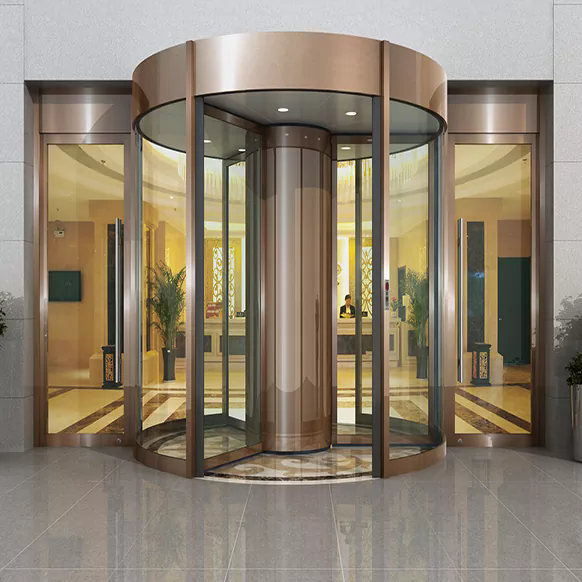
Table of Contents
What Is a Revolving Door?
A revolving door is a type of entrance system consisting of multiple wings or panels that rotate around a central shaft. Unlike sliding or swing doors, it maintains a continuous seal between indoor and outdoor environments. This structural design minimizes uncontrolled air exchange, reducing energy loss caused by heating or cooling leakage.
The system is widely used in high-traffic buildings where environmental control and crowd management are critical. Modern revolving doors often integrate automatic sensors, speed control systems, and safety mechanisms to ensure smooth operation.
Working Principle of Revolving Doors
The operational principle of a revolving door is based on compartmentalized rotation. The door consists of three or four wings attached to a central vertical axis. As users push or the motor drives rotation, each compartment allows one or more individuals to pass while maintaining a partial barrier between interior and exterior air.
Core mechanisms include:
- Central shaft rotation system (manual or automatic)
- Segmented enclosure to control airflow exchange
- Speed regulation system for safety control
- Sensor-based stop function for obstruction detection
This controlled movement significantly reduces the "chimney effect," where conditioned air escapes through open entrances.
Key Benefits in Modern Buildings
Revolving doors provide a wide range of functional and economic benefits, especially in energy-intensive environments.
| Benefit | Description |
|---|---|
| Energy Efficiency | Reduces HVAC loss by maintaining stable indoor and outdoor separation. |
| Climate Control | Minimizes drafts, dust, and temperature fluctuations. |
| Traffic Management | Ensures smooth pedestrian flow in high-traffic environments. |
| Security Enhancement | Prevents unauthorized rapid entry and improves access control. |
| Noise Reduction | Helps block external noise pollution in urban buildings. |
These advantages make revolving doors a preferred choice for sustainable architecture and smart building design.
Common Applications
Revolving doors are widely used across multiple industries due to their versatility and efficiency.
- Commercial office buildings and skyscrapers
- Luxury hotels and resorts
- Airports and transportation hubs
- Hospitals and healthcare facilities
- Shopping malls and retail centers
In each environment, they contribute differently—whether improving passenger flow in airports or maintaining sterile conditions in hospitals.
How to Choose the Right Revolving Door
Selecting the appropriate revolving door requires evaluating structural, functional, and environmental factors.
Key selection criteria include:
- Building traffic volume (low, medium, high)
- Manual vs automatic operation
- Material durability (aluminum, stainless steel, glass)
- Energy efficiency rating
- Security integration capabilities
Choosing the correct configuration ensures long-term performance and reduces maintenance costs.
Installation and Maintenance Considerations
Proper installation is critical to ensure safe and efficient operation of revolving doors. Misalignment or improper calibration can lead to performance issues and safety risks.
Installation checklist:
- Structural load assessment of entry frame
- Precise shaft alignment calibration
- Electrical system integration for automated models
- Safety sensor testing and validation
Routine maintenance should include lubrication of mechanical parts, inspection of sensors, and periodic safety testing.
Safety and Compliance Standards
Modern revolving doors must comply with international safety standards to ensure user protection. Features such as emergency stop functions, anti-pinch sensors, and speed limiters are mandatory in many commercial installations.
Regulatory compliance helps reduce liability risks and ensures smooth approval during building inspections.
Common Problems and Solutions
Like any mechanical system, revolving doors may experience operational issues over time. Below is a structured overview of common problems and their solutions.
| Issue | Possible Cause | Solution |
|---|---|---|
| Slow rotation | Mechanical friction or motor wear | Lubrication and motor inspection |
| Sensor malfunction | Dust or misalignment | Cleaning and recalibration |
| Air leakage | Seal degradation | Replace sealing components |
Duoping Engineering Solutions
Duoping specializes in designing and manufacturing high-performance revolving door systems tailored for modern architectural demands. With a focus on durability, energy efficiency, and user safety, Duoping integrates advanced engineering techniques into every product line.
- Custom-built revolving door systems for commercial projects
- Energy-efficient structural design optimization
- Advanced sensor and automation integration
- Long-term maintenance and technical support
By combining precision manufacturing with innovative design, Duoping delivers solutions that enhance building performance and operational efficiency.
FAQ
1. Are revolving doors energy efficient?
Yes, they significantly reduce air exchange between indoor and outdoor environments, lowering HVAC energy consumption.
2. Can revolving doors be used in emergency exits?
Some models include breakout panels or adjacent swing doors to meet emergency egress requirements.
3. How long does a revolving door last?
With proper maintenance, high-quality systems can last over 15–20 years.
4. Are automatic revolving doors safe?
Yes, modern systems include multiple sensors and safety mechanisms to prevent accidents.
Conclusion
Revolving doors represent a critical intersection of architecture, engineering, and sustainability. They improve energy efficiency, enhance user flow, and elevate building aesthetics. With proper selection, installation, and maintenance, they can deliver long-term operational value across various industries.
Duoping continues to innovate in this field, offering reliable and high-performance revolving door solutions designed for modern infrastructure needs.
For customized solutions, technical consultation, or project collaboration, contact us at Duoping today to explore how our revolving door systems can upgrade your building performance and efficiency.
Send Inquiry
-
E-mail
X
We use cookies to offer you a better browsing experience, analyze site traffic and personalize content. By using this site, you agree to our use of cookies.
Privacy Policy
News
 Explaining the key points and safety guidelines for installing white glass2026/01/28
During the installation process, precise operation and detailed handling are particularly crucial. For the installation of white glass in different scenarios, differentiated specifications must be followed. When installing white glass for doors and windows, the glass surface orientation must comply ......
 Know these 6 key indicators of aluminum alloy door and window materials!2026/01/28
The series number indicates the thickness of the door frame in millimeters. Aluminum alloy sliding doors are available in 70 and 90 series; the 70 series is sufficient for interior residential aluminum alloy sliding doors.